

Textile wastewater can contain dyes, sizing agents, surfactants, suspended fibers and other process chemicals. Its composition varies with the fabric, dyeing process and production schedule. A treatment program using polyacrylamide for textile wastewater treatment can help form larger flocs and improve solid-liquid separation. In many applications, polyaluminium chloride (PAC) is used as a coagulant before PAM is added as a flocculant.
Textile Wastewater Treatment Challenges
Textile wastewater characteristics depend on the specific production process. Common treatment challenges include:
- Color from dyes and pigments
- Fine suspended solids, fibers and colloidal particles
- Fluctuating pH and wastewater composition
- Surfactants and auxiliaries that can affect floc formation
- Slow settling or difficult sludge dewatering
Because wastewater varies from plant to plant, chemical selection should be based on a representative water sample and jar testing.
How PAC and Polyacrylamide Work Together
PAC is a coagulant. It helps destabilize fine suspended and colloidal particles so they can begin to aggregate. Polyacrylamide (PAM) is a polymer flocculant. Its long molecular chains can bridge smaller particles and help form larger flocs that are easier to settle, float or separate by filtration.
A common treatment sequence is PAC addition followed by PAM addition. The best PAC grade, PAM type and dosing conditions depend on the wastewater. Anionic PAM (APAM) or cationic PAM (CPAM) may be evaluated during testing; neither type is automatically suitable for every textile wastewater.
Typical Treatment Process
- Screening and equalization: Remove coarse fibers and even out flow and wastewater quality where possible.
- Adjust pH if required: Test the raw water and adjust pH when needed for the selected treatment chemicals.
- Add PAC: Mix the coagulant into the wastewater to promote particle destabilization.
- Add diluted PAM: Prepare PAM according to the product guidance, then add it gradually with suitable mixing.
- Separate the flocs: Allow flocs to settle or use the plant’s flotation or filtration equipment.
- Evaluate the result: Check supernatant clarity, floc size, settling behavior and sludge handling performance.
How to Select Polyacrylamide for Textile Wastewater
The suitable PAM grade depends on wastewater characteristics and the separation equipment. During selection, consider:
- Whether the wastewater is mainly dyeing, printing, washing or finishing wastewater
- Particle and colloid characteristics, pH and existing treatment chemicals
- Whether the process uses sedimentation, dissolved air flotation or filtration
- Floc formation, settling or flotation behavior, and sludge dewatering needs
- Polymer dissolution and preparation conditions at the treatment plant
Compare candidate PAM grades using the same wastewater sample and consistent mixing conditions. Select the grade that meets the treatment objective while remaining practical for preparation, dosing and sludge handling.
Jar Testing Before Full-Scale Dosing
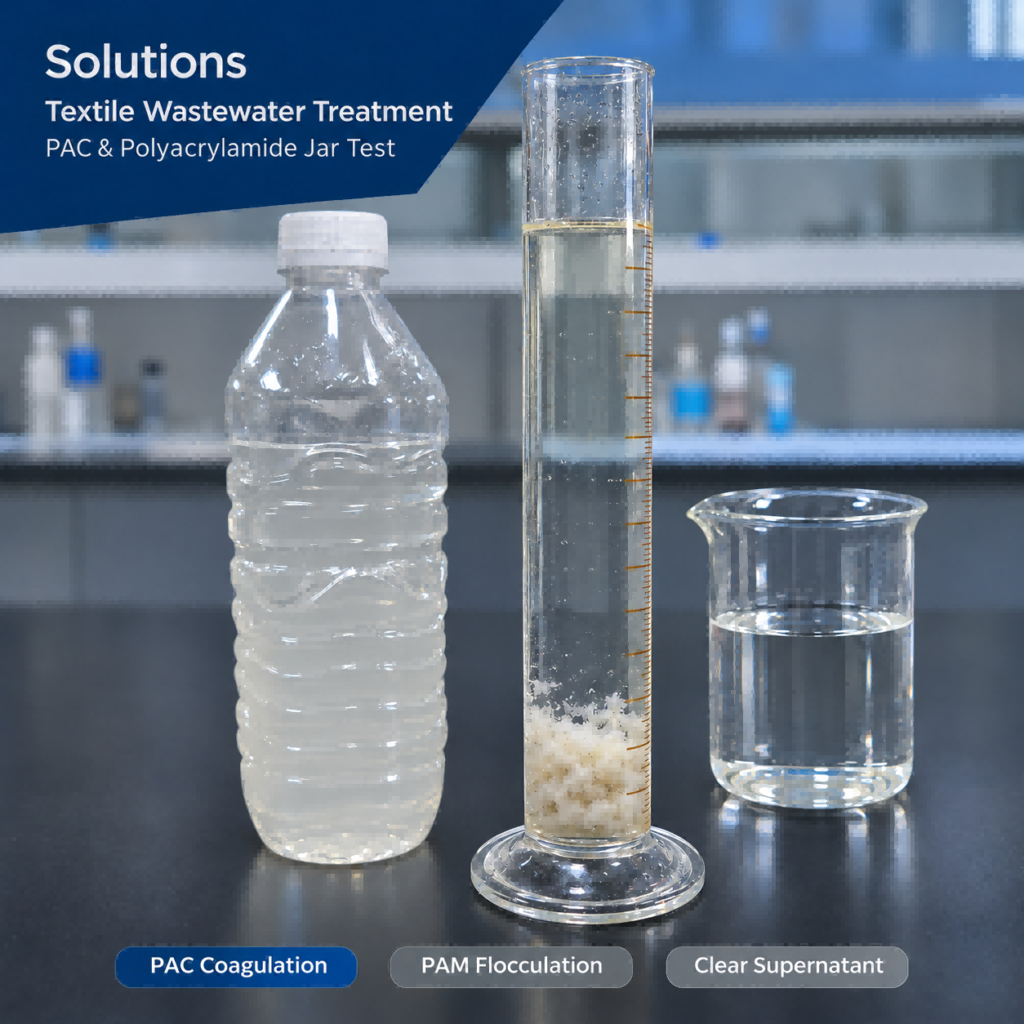
A jar test helps compare PAC and PAM combinations before making changes to plant operation. Use a representative wastewater sample, test one variable at a time, and record the chemical grade, solution concentration, addition sequence, mixing conditions and observed results.
Evaluate floc formation, settling or flotation, supernatant appearance and sludge characteristics. The optimum dosage must be established by testing; avoid applying a fixed dosage from another factory without checking the wastewater and process conditions.
What Polyacrylamide Can and Cannot Do
Polyacrylamide can support flocculation and solid-liquid separation when the selected grade and process conditions are suitable. It does not destroy dissolved dyes or remove all dissolved organic compounds by itself. If color, COD or other dissolved pollutants remain above the required limits, additional treatment stages may be needed based on water analysis and local discharge requirements.
Frequently Asked Questions
Can polyacrylamide remove color from textile wastewater?
PAM mainly supports floc formation and separation. Color removal depends on the type of dye and whether it is dissolved, colloidal or attached to suspended solids. Jar testing can show whether PAC and PAM are sufficient or whether additional treatment is needed.
Should PAC or PAM be added first?
A common sequence is PAC first, followed by diluted PAM, but the best sequence and mixing conditions should be confirmed with a jar test.
Is APAM or CPAM better for textile wastewater?
There is no universal answer. Compare suitable grades using the actual wastewater and treatment equipment. The best choice is the one that delivers the required separation and sludge performance under practical operating conditions.
How much PAM should be used?
The required amount varies with wastewater composition, chemical grade, PAC conditions and equipment. Establish the dosage through jar testing and confirm it during controlled plant trials.
Need Help Selecting PAM for Textile Wastewater?
TRONKI can help evaluate wastewater samples and compare suitable PAM grades for textile wastewater treatment. Contact our team with your water characteristics, current treatment process and separation equipment to discuss a practical testing plan.